


How many pillar 3a accounts can you have?
In Switzerland there is no legal upper limit on the number of 3a accounts. In theory you can open 10 or 20 pillar 3a accounts, also with different providers. In practice, some providers limit their offering to a maximum of 5 accounts per person.
Important to know: the annual maximum amount (2026: CHF 7'258 for working people with a pension fund) applies per person, not per account. Anyone with several accounts can’t pay it in more than once. For tax reasons, you should make sure that not too much balance accumulates in a single 3a account or custody account.
Why the amount per account matters more than the number
The number of accounts alone gets you nothing. What matters is how much money is in each individual account at the time of withdrawal. The reason: the lump-sum withdrawal tax (= one-off tax on withdrawing your 3a money) is calculated progressively. The higher the individual withdrawal, the higher the tax rate on the entire amount.
A simplified example: anyone who has CHF 250'000 paid out in a single withdrawal pays proportionally considerably more tax than someone who spreads five withdrawals of CHF 50'000 over five years. Depending on the canton of residence, that amounts to several thousand francs.
This leads to a rule of thumb: at withdrawal, no more than CHF 50'000 should be in any one 3a account. For that to work, two levers have to interact: the right split while saving and staggered withdrawal at retirement.
The lump-sum withdrawal tax simply explained
When you withdraw your 3a assets, a lump-sum withdrawal tax is due. It is levied at federal, cantonal and municipal level, calculated once and taxed separately from your other income at a reduced rate.
Three points matter here:
1. The lump-sum withdrawal tax is progressive
The higher the amount withdrawn, the higher the tax rate. That applies to the federal tax as well as the cantonal and municipal taxes. The federal tax is one fifth of the regular tariff; cantonal tax rates vary considerably.
2. Withdrawals in the same year are added together
Anyone who withdraws several 3a accounts or custody accounts in the same calendar year is taxed as if it were a single withdrawal. Specifically: if you close two 3a accounts in the same year, the tax administration adds the two amounts together to calculate the tax rate.
This also applies to withdrawals from the pension fund and the vested benefits account. How to stagger vested benefits withdrawals is explained in our guide Withdrawing from a vested benefits account.
3. Your place of residence at withdrawal decides
What counts is your place of residence on the day of payout, not the canton in which the account is held. Anyone living in a low-tax canton pays considerably less on withdrawal than in a high-tax canton.
From what balance is a second 3a account worthwhile?
As soon as a 3a account passes the CHF 50'000 mark, opening a second account pays off. With an annual contribution of CHF 7'258, this threshold is reached after around 6 to 7 years. Interest or securities income can bring that point forward.
The CHF 50'000 is a rule of thumb, not a fixed value. How much per account makes sense depends on the progression of the lump-sum withdrawal tax in your canton of residence. Some cantons, such as St. Gallen, Thurgau or Uri, tax lump-sum benefits linearly; there, splitting brings hardly any saving. You can calculate how high the tax is in your canton for a given amount yourself with the official FTA tax calculator for lump-sum benefits.
Important: even though tax rates differ, the same principle applies almost everywhere. Several smaller withdrawals in different years are cheaper for tax purposes than a single large withdrawal.
How many accounts make sense in practice?
Three to five 3a accounts are the right number for most savers. More brings little tax benefit, because only six withdrawal years are available for ordinary withdrawal (earliest withdrawal 5 years before the reference age, with the withdrawal year counting). Anyone with more accounts inevitably has to withdraw several in the same year, and the splitting advantage is lost.
Staggered withdrawal: the second half of the strategy
Splitting contributions across several accounts alone doesn’t save any tax. What matters is that the accounts are withdrawn in different tax years. Otherwise the tax administration adds the amounts together and the advantage is gone.
The rules:
- 5-year window: pillar 3a can be withdrawn at the earliest 5 years before the reference age of 65. Since the year of retirement counts, that makes 6 withdrawal years, one each from age 60 to 65.
- Deferral if you keep working: anyone who keeps working beyond the reference age can defer withdrawal by up to 5 years. The window then extends to up to 11 withdrawal years.
- One account = one withdrawal: on ordinary withdrawal, you can only withdraw a 3a account in full; there is no partial withdrawal (exception: early withdrawal for owner-occupied residential property). That is why you have to plan the split when opening the accounts. Anyone who enters retirement with a single large account can’t split it afterwards.
- Stagger the pension fund: anyone planning a lump-sum withdrawal from the pension fund shouldn’t make it in the same year as a 3a withdrawal. Otherwise the amounts are added together for tax progression.
Example staggering for a person retiring at 65:
- Age 60: withdraw account 1
- Age 61: withdraw account 2
- Age 62: withdraw account 3
- Age 63: withdraw pension fund (if lump sum)
- Age 64: withdraw account 4
- Age 65: withdraw account 5
This is an illustrative example. It pays to plan the various withdrawals in line with your personal circumstances.
How many accounts does that mean in concrete terms? In theory, you could set up one account for each withdrawal year. In practice, the number is smaller, because almost everyone also withdraws pension fund or vested benefits assets, which also occupy withdrawal years. Realistically sensible are:
- 5 accounts for withdrawal at the reference age
- up to 10 accounts if withdrawal is deferred
For married couples, this number halves per person, because simultaneous withdrawals by both partners are generally added together. Around 2 to 3 accounts per person then make sense for ordinary withdrawal. If there is an age difference of more than 5 years, both partners can place their withdrawals in different years, which makes more accounts sensible again.
Example calculation: one account vs. five accounts
Assumption: a 60-year-old man, no religious affiliation, resident in the city of Zurich, has saved CHF 250'000 in pillar 3a. Two scenarios compared, calculated with the FTA tax calculator (tax year 2026).
Scenario 1: one account of CHF 250'000, a single withdrawal
| Withdrawal amount | CHF 250'000 |
| Lump-sum withdrawal tax | CHF 14'601 |
| Effective tax rate: | approx. 5.8 % |
Scenario 2: five accounts of CHF 50'000, staggered withdrawal
| Withdrawal amounts | Year 1: CHF 50'000; year 2: CHF 50'000; year 3: CHF 50'000; year 4: CHF 50'000; year 5: CHF 50'000 |
| Lump-sum withdrawal tax | CHF 11'100 (CHF 2'220 per withdrawal) |
| Effective tax rate: | approx. 4.4 % |
Saving through splitting and staggered withdrawal: around CHF 3'500.
The saving depends on the progression of the lump-sum withdrawal tax in your canton of residence at withdrawal.
Pillar 3a accounts with different providers
Several 3a accounts with the same provider are possible almost everywhere. What should you bear in mind?
- Combine different investment styles. With many providers (e.g. frankly, finpension, neon) you can hold several 3a accounts with different investment strategies. With just one provider, however, the choice remains limited to the in-house range. One account on a pure interest basis at a bank with an attractive pension interest rate, a second as a securities solution at a foundation with a low TER (= a fund’s total annual costs), possibly a third at a provider with a high equity share: this mix diversifies beyond the actual investment product.
- Benefit from welcome bonuses. Many 3a providers reward new customers with welcome offers such as fee discounts. Anyone opening a second or third 3a account or custody account should actively check such promotions instead of simply staying with their existing provider. You’ll find a current overview of ongoing promotions on the Evaluno deals page.
A selection of attractive pillar 3a offers for new customers

CHF 35 fee credit at frankly
With the frankly code Evaluno35 you receive a fee credit of CHF 35 when opening your frankly pillar 3a from ZKB.
View deal
CHF 25 credit at finpension
With the finpension code PQMK7S you receive a fee credit of CHF 25 for finpension 3a, Invest or vested benefits.
View deal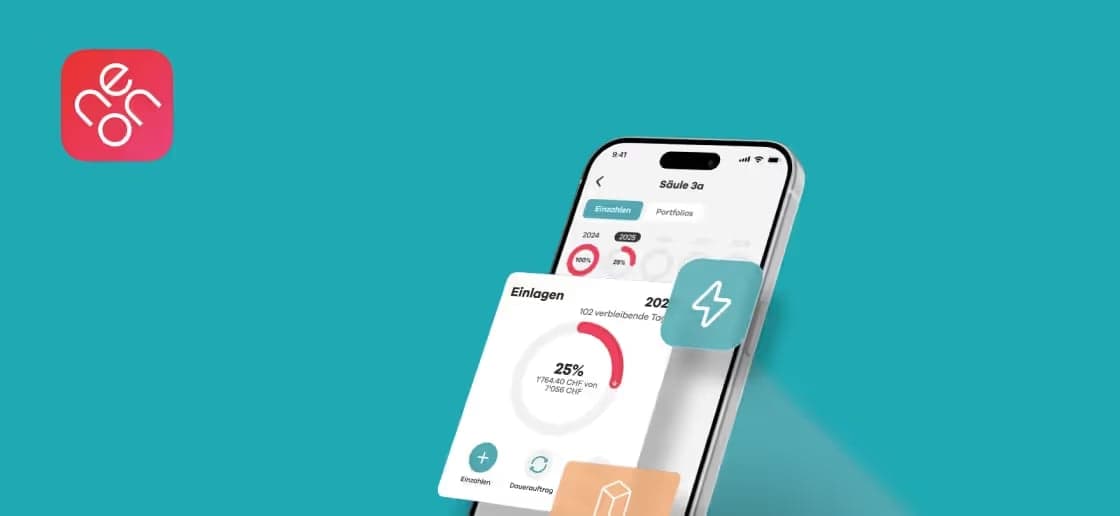
CHF 40 bonus at neon
With the neon code EVANEO you receive a CHF 20 starting credit and a free neon Debit Mastercard (worth CHF 20).
View dealFrequently asked questions
Yes. To calculate the lump-sum withdrawal tax, the tax administration adds together all lump-sum withdrawals from the second and third pillars in the same calendar year. That also applies across cantonal borders. Anyone planning a lump-sum withdrawal from the pension fund should therefore place it in a year without a 3a withdrawal — otherwise the splitting advantage is largely cancelled out.
No. An account can only be transferred in full or paid out in full on withdrawal, not split. Anyone who wants to split afterwards can transfer the saved money to a new account with another provider — but always the entire balance, not a part. That is why splitting pays off as early as possible.
Legally there is no limit. For tax purposes, a maximum of five accounts usually makes sense, because ordinary withdrawal only has six years available and one should be reserved for a possible pension fund withdrawal. Some foundations internally limit the number of accounts per customer to five.
A new account purely for tax optimisation only pays off if enough time remains for substantial contributions. Anyone less than five years away from ordinary withdrawal can still fund the new account but can no longer fully exploit the splitting advantage over several years. In this phase, the question of the optimal withdrawal timing takes centre stage.
No. Pillar 3a assets are not part of taxable wealth and appear in the tax return for information only. That applies regardless of the number of accounts.
On transfer, the entire balance of an account is moved to a new provider. For tax purposes this is neutral; no federal tax is due on switching. The outgoing foundation may, however, charge a transfer fee — check the conditions before switching.
No. Only assets built up during the marriage count as acquired property and are split in half. Accounts that existed before the marriage remain personal property. The exact delineation can become complex if an account existed before the marriage and continued to be funded during it; a clarification by a specialist is then worthwhile.
Anyone who pays less than CHF 3'000 a year into 3a and will probably accumulate less than CHF 30'000 in total sees hardly any tax advantage from splitting. A single account is usually sufficient in that case. But as soon as the assets grow noticeably — for example thanks to ETF or fund gains from a securities solution — the question of splitting should be reassessed.
Legal disclaimer
Evaluno does not provide investment, legal or tax advice and is no substitute for personal advice.