What is an ETF savings plan?
With an ETF savings plan, you automatically buy units of one or more ETFs at fixed intervals, usually monthly. An ETF (exchange-traded fund) tracks an entire index, such as the MSCI World or the SMI, and thereby spreads your money across hundreds of companies. Instead of trying to time the market, you invest the same amount regularly. When prices are low you receive more units; when they are high, fewer. This averaging effect (cost averaging) and compound interest over the years are the key advantages over a savings account.
For Swiss investors, an ETF savings plan is attractive above all because it is cheap, transparent and works without much effort. You don’t need any prior knowledge of individual shares and, depending on the provider, can start from just a few francs a month.
Our guide to ETF savings plans explains everything you need to know in plain language.
Pick your own ETFs or choose a strategy?
Swiss ETF savings plans fall into two groups, and this distinction determines which provider suits you.
With an ETF savings plan where you pick your own ETFs, you decide which ETFs to save into and build your own portfolio. You have full control and usually the lower running costs, but you also bear the responsibility for the selection yourself. Typical providers are brokers such as Swissquote and Saxo or the savings plans of PostFinance and neon.
With a strategy-based savings plan, you choose a ready-made investment strategy based on your risk profile. The provider then invests automatically in a predefined portfolio of ETFs or index funds and manages it for you on an ongoing basis. That is more convenient and good for getting started, but usually costs a little more through the management fee. Typical providers are VIAC, finpension, True Wealth, Selma and findependent.
Some providers such as neon or finpension offer both, so you can pick your own ETFs there or use a strategy.
What does an ETF savings plan cost?
The costs of an ETF savings plan are made up of two levels, and it is precisely this distinction that many comparisons overlook.
Costs per contribution are incurred with every purchase:
brokerage or execution fee for the purchase
currency markup (FX markup) if the ETF is not traded in francs
Swiss federal stamp duty (transfer tax)
Running costs per year are incurred regardless of purchases:
TER (total expense ratio) of the ETF itself
custody or management fee of the provider, often as an all-in fee at strategy-based providers
A Swiss particularity is stamp duty: it amounts to 0.075 % for Swiss ETFs and 0.15 % for foreign ETFs, and is only charged by Swiss brokers. Providers that use Swiss index funds instead of ETFs (VIAC, for example) pay no stamp duty, because the issue of domestic fund units is exempt.
ETF savings plan or fund savings plan: which is better?
Both work on the same principle: you save regularly into a fund. The difference lies in the fund itself. An ETF passively tracks an index and is therefore cheap, with a TER often below 0.3 percent. A conventional (actively managed) fund tries to beat the market and usually costs considerably more, often over 1 percent per year.
Over long periods, this cost difference weighs heavily, because it multiplies through compound interest. For most investors who want to build wealth simply and cheaply, an ETF savings plan is therefore the obvious choice. An active fund savings plan can make sense if you are specifically looking for a strategy that isn’t available as an ETF.
What to look for when choosing
There is no single best ETF savings plan, because it depends on your situation. These criteria help you decide:
- Total costs: look at the TER together with brokerage, currency markup and custody fee, not the TER alone.
- Product type: do you want to pick your own ETFs or take a ready-made strategy?
- Minimum contribution: some providers start from a few francs, others require higher amounts.
- ETF selection: how many ETFs are available, and which ones?
- Interval and flexibility: can you pause, adjust or make additional contributions?
- Electronic tax statement: does the provider issue an electronic tax statement, and is it free? That saves you a lot of effort on your tax return.
- Regulation and deposit protection: is the provider supervised in Switzerland?
Who is an ETF savings plan worth it for?
An ETF savings plan is worthwhile for almost anyone who wants to build wealth over the long term with manageable effort. It makes particular sense if you have an investment horizon of at least five to ten years, can invest a fixed amount regularly and want to sit out price fluctuations instead of hunting for the perfect entry point. What matters is less the size of the contribution than its regularity. Even small amounts add up over the years, because the returns go back to work. If you need the money in the short term, a savings account serves you better, because an ETF savings plan can fluctuate over short periods.
ETF savings plan providers in Switzerland at a glance
In the comparison you’ll find the most important Swiss providers, grouped by product type. Providers where you pick your own ETFs include Swissquote, Saxo, PostFinance, neon, Yuh and Revolut. Strategy-based investing is offered by VIAC, finpension, True Wealth, Selma, findependent and Alpian, among others.
Swissquote ETF savings plan
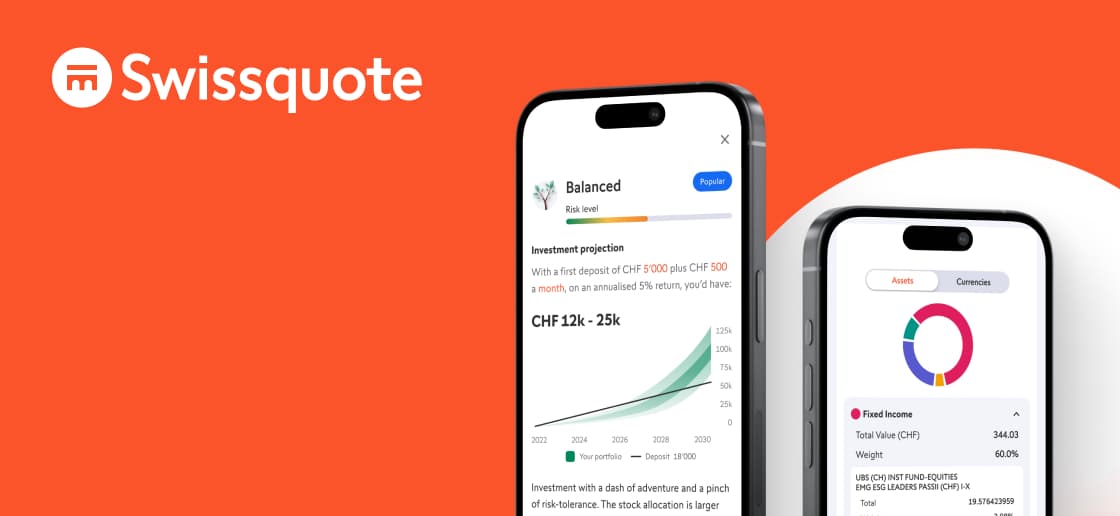
With the Swissquote ETF savings plan, you pick from around 115 ETFs yourself and save regularly into your own custody account. Swissquote is Switzerland’s largest online broker and is regulated in Switzerland. The selection is broad; in return, an execution fee per purchase and an annual custody fee apply, which is why the savings plan suits mainly self-directed investors with larger amounts. You’ll find the exact costs in the comparison.
Saxo ETF savings plan
With Saxo’s ETF savings plan (Saxo AutoInvest), you pick from around 103 ETFs yourself and set up monthly purchases, executed on the 5th of each month. Saxo Bank is regulated in Switzerland and combines a broad ETF selection with free savings plan executions, no custody fee and a low currency markup. That makes Saxo one of the cheapest providers on costs. You’ll find the details in the comparison.
Currently, new customers receive CHF 200 in trading credits via Evaluno. Link: Saxo voucher from Evaluno.
Yuh ETF savings plan
With the Yuh ETF savings plan, you build your own portfolio from around 60 ETFs directly in the app and save from as little as CHF 10, with no custody fee at all. Yuh is a simple Swiss finance app and is particularly suited to beginners who want to start easily via smartphone and with small amounts. Thanks to fractional purchases, even a small contribution is invested in full. You’ll find the exact costs in the comparison.
Currently, with the Yuh promo code YUHEVALUNO, new customers receive CHF 50 in trading credits and 250 Swissqoins (SWQ) via Evaluno. Link: Yuh promo code from Evaluno.
PostFinance ETF savings plan
With the PostFinance ETF savings plan, you invest automatically via PostFinance e-trading in a selection of around 110 ETFs. The savings plan is mainly suited to existing PostFinance customers who want to start building wealth without an additional banking relationship. The execution costs are rather high by comparison, though; you’ll find the current figures in the ETF savings plan comparison.
UBS key4 smart investing
With the ETF savings plan from UBS key4 smart investing, you choose from 9 ETFs and have your contribution invested automatically every month. The offer comes from a major Swiss bank, is FINMA-regulated and is aimed at anyone who wants to invest simply and automatically. In return, the ETF selection is smaller and an annual custody fee applies. The costs are rather high compared with other ETF savings plan providers.