
Joint account comparison Switzerland 2026: the best accounts for couples and flatshares



A joint account – also called a partner account – is a bank account with two or more equal holders who can usually each dispose of the balance individually. Evaluno has compared 8 joint accounts from Swiss banks and neobanks: costs, cards, TWINT, use abroad and opening requirements. Whether you’re a couple, a flatshare or another kind of household, the comparison shows you straight away which offers suit you.
The key facts in brief
- A joint account in Switzerland costs between CHF 0 and CHF 15 per month. Yuh and ZKB offer a free joint account including two cards and without preconditions.
- Which joint account suits you depends on how you use it. If you regularly withdraw cash in Switzerland, check the withdrawal fees; if you also use the card abroad or order online in foreign currencies, check the exchange rate markup.
- Individual signing authority is the standard: each person can dispose of the entire balance alone. Trust is the basic requirement for a joint account.
- Most joint accounts are designed for a maximum of 2 people; accounts for more than 2 people are only available from ZKB, Raiffeisen and UBS. neon and UBS require a shared address; at Migros Bank it is only needed for the free second card.
8 joint accounts compared
Data as of:
| Provider |  Yuh&Me Gemeinschaftskonto |  ZKB Partnerkonto |  Neon Duo Partnerkonto |  PostFinance Gemeinschaftskonto |  Migros Bank Gemeinschaftskonto |  Raiffeisen Gemeinschaftskonto |  Bank WIR Gemeinschaftskonto |  UBS me Familien & Paare |
|---|---|---|---|---|---|---|---|---|
| Account fee per month | free | free | CHF 6 | CHF 5 | free | free | free | CHF 15 |
| Cards | 2 Debit Mastercards included | 2 Visa debit cards included | 2 Debit Mastercards at CHF 10 each | 2 PostFinance Cards included | 1 debit card included, 2nd card CHF 30/year | 1 debit card included, 2nd card CHF 30-40/year | 2 Debit Mastercards included | 2 debit and credit cards included |
| TWINT | Yes | Yes | TWINT Prepaid | Yes | Yes | Yes | Yes | Yes |
| eBill | Yes | Yes | Yes | Yes | Yes | Yes | Yes | Yes |
| Shared residence required | No | No | Yes | No | No | No | No | Yes |
| Number of holders | 2 | 2+ | 2 | 2 | 2 | 2+ | 2 | 2+ |
| Special features | Both persons need their own Yuh account. 1 physical + 1 virtual card per person included. Insurance, shared saving pots and multi-currency account. | Optional paid ZKB packages (CHF 6-16/month) for credit cards. | Both persons need their own neon account. TWINT only as prepaid, not from the account. Shared residence mandatory. | Free with invested assets from CHF 25'000, a mortgage or life insurance. SmartPlus for CHF 10 with credit card and free cash withdrawals. | Shared residence only required for free additional cards | Prices vary by regional bank. Membership via cooperative share from CHF 200. | Requires the top banking package: incoming payments from CHF 1'500/month, pension assets from CHF 20'000, a mortgage from CHF 300'000 or a one-off CHF 200 cooperative share. | First 6 months free, most expensive foreign-currency conditions in the comparison |
| Opening offers | CHF 50 in trading credits with code YUHEVALUNOView deal | — | CHF 40 credit with code EVANEOView deal | — | — | — | — | — |
Source: provider websites, product documents and direct information from providers, as of .
All information without guarantee, rates and fees can change at any time. Evaluno earns a commission when an account is opened through some of these links. This does not change the results or their ranking. Evaluno’s methodology
What is a joint account?
A joint account is a bank account held in the name of two or more people and used by all of its holders. Depending on the bank, it is also called a partner account, shared account or household account. In Switzerland it is almost always run as a so-called “or” account: each person can trigger payments, withdraw money and view the account alone, without the other having to agree. All holders are jointly and severally liable, for example if the account goes into the red.
The best joint account for use in Switzerland
If you use the joint account mainly in Switzerland, Evaluno recommends these two offers:
Recommendation
Yuh&Me joint account
The joint account of the neobank Yuh (owned by Swissquote) works as an additional account alongside both people’s personal Yuh accounts.
- Advantage: Free account management and cards
- Advantage: TWINT directly from the shared account
- Advantage: No shared address required
- Advantage: eBill, CH IBAN, shared savings pots, multi-currency account
- Disadvantage: 1 free cash withdrawal per week, then CHF 1.90
- Disadvantage: No branches
Alternative
ZKB partner account
The partner account of ZKB, Switzerland’s largest cantonal bank. It is part of the “ZKB Banking” package and is available on request for more than 2 people.
- Advantage: Free account management and cards
- Advantage: Branches and personal advice
- Advantage: TWINT, eBill, CH IBAN
- Advantage: Possible for more than 2 people
- Disadvantage: 1.25 % exchange rate markup
- Disadvantage: No virtual cards as at Yuh
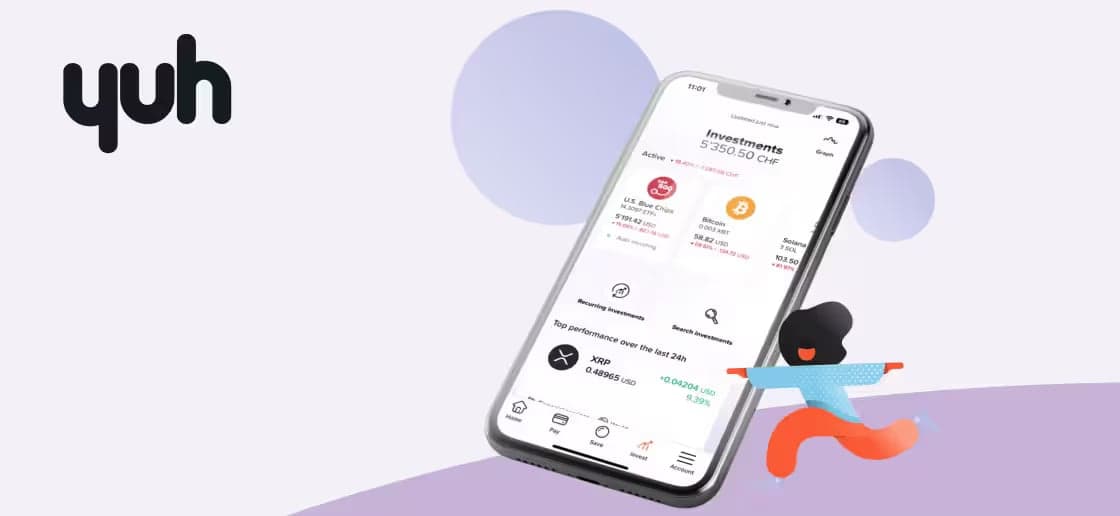
Attractive welcome offer for your Yuh joint account
The best joint account for use in Switzerland and abroad
If you also use the joint account abroad, e.g. for cash withdrawals and payments in foreign currencies or in foreign online shops, Evaluno recommends these two offers:
Frequent use abroad
neon duo partner account
The partner account of the neobank neon works as an additional account alongside both people’s personal neon accounts.
- Advantage: Low exchange rate markup (+0.35 %)
- Advantage: Cash withdrawals abroad with a 1.5 % surcharge (cheaper than Yuh for withdrawals under 350 euros)
- Advantage: eBill, CH IBAN, shared savings pots, multi-currency account
- Disadvantage: TWINT only via the prepaid app (a dedicated TWINT app has been announced)
- Disadvantage: Shared address mandatory
- Disadvantage: Monthly basic fee of CHF 6 + one-off CHF 10 per card
Occasional use abroad
Yuh&Me joint account
The joint account of the neobank Yuh (owned by Swissquote) works as an additional account alongside both people’s personal Yuh accounts.
- Advantage: Free account management and cards
- Advantage: TWINT directly from the shared account
- Advantage: No shared address required
- Advantage: eBill, CH IBAN, shared savings pots, multi-currency account
- Disadvantage: 0.95 % exchange rate markup
- Disadvantage: Cash withdrawals abroad: CHF 4.90 per withdrawal
The most striking difference: neon duo requires a shared address, Yuh&Me doesn’t. For couples with two separate flats or rooms in a flatshare, for long-distance relationships or siblings sharing common costs, that is a deal-breaker.
From what volume abroad does which account pay off?
For pure card spending abroad (without cash withdrawals), neon duo pays off from around CHF 12'000 in foreign currency per year; below that, the free Yuh&Me account is cheaper. With cash withdrawals abroad, this threshold drops:
- Yuh&Me charges CHF 4.90 per withdrawal and a 0.95 % exchange rate markup
- neon duo charges 1.5 % of the amount withdrawn and a 0.35 % exchange rate markup
If you regularly travel abroad or generally generate a high foreign-currency volume with your cards, the neon duo joint account is cheaper than Yuh’s. The calculation shows, by way of example, where the threshold lies.
Comparison by withdrawals abroad and foreign-currency volume
| Withdrawals abroad per year at EUR 250 | Yuh&Me cheaper up to a card volume abroad of |
|---|---|
| 0 withdrawals | ≈ CHF 12'000 |
| 12 (= once a month) | ≈ CHF 6'400 |
| 24 withdrawals (= twice a month) | ≈ CHF 850 |
| from 26 withdrawals | neon duo always cheaper |
Source: Provider data (neon duo = 0.35 % exchange rate markup + 1.5 % per withdrawal; Yuh&Me = 0.95 % exchange rate markup + CHF 4.90 per withdrawal)
Cash withdrawals in Switzerland with neon duo and Yuh&Me
If you regularly withdraw cash in Switzerland, bear in mind the different conditions of the two joint accounts from neon and Yuh.
- neon duo: 2 free cash withdrawals per month, each additional withdrawal costs CHF 2.50.
- Yuh&Me: 1 free cash withdrawal per week, each additional withdrawal costs CHF 1.90.
For cash withdrawals in Switzerland, the Yuh joint account is slightly more attractive than the neon partner account. That only matters if you also use the card frequently for cash withdrawals.
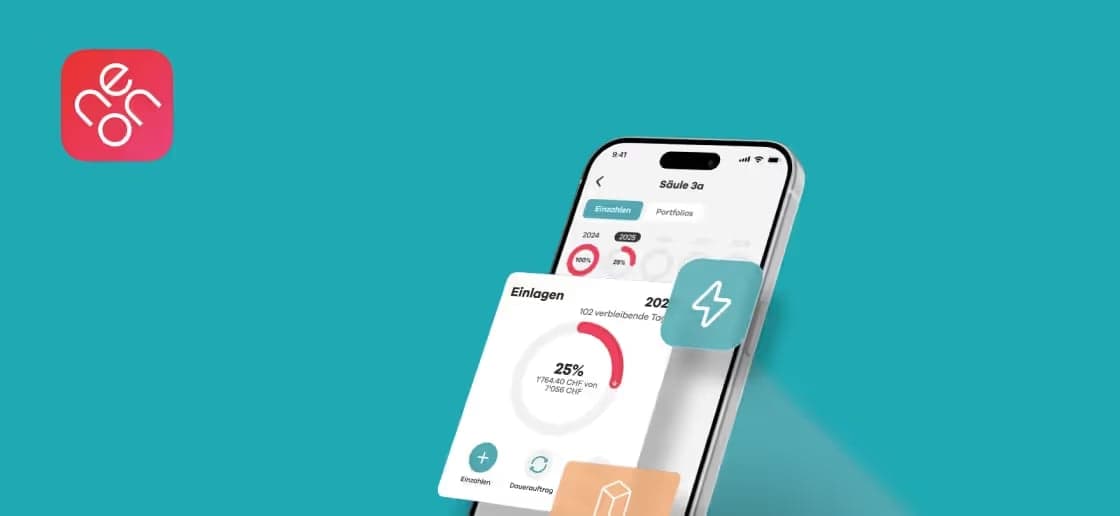
Current promo codes for joint accounts
How does a joint account work in everyday life?
In everyday life, the joint account serves as the hub for all shared expenses: both people transfer a fixed amount each month or have their entire salary paid into it, and all shared bills run through this one account. Typical shared costs in a Swiss household are rent, utilities, Serafe, household insurance, groceries and streaming subscriptions. Couples in particular also like to use the joint account for holidays, outings or meals in restaurants, or for shared purchases for the home such as furniture. When using it abroad and for orders from foreign online shops, be sure to also consider the fees for cash withdrawals abroad and the exchange rate markup.
How much does a joint account cost per month?
A joint account in Switzerland costs between CHF 0 and CHF 15 per month (as of 19 August 2026). Yuh&Me and the ZKB partner account are free, with two cards included and no further conditions. Bank WIR also offers a free joint account (with an access condition), as do Migros Bank (second card charged, unless you share an address) and Raiffeisen (for members). PostFinance charges CHF 5 per month for the couple, neon duo CHF 6 per month (CHF 3 per person) and UBS me from CHF 15 per month.
Joint account, shared account, partner account or household account: what’s the difference?
There is none: all these terms describe the same account model. Joint account is the official banking term, partner account and couple’s account are used colloquially for couples, and household account emphasises the purpose, namely paying shared household costs such as rent, health insurance and groceries. A flatshare account is also a joint account, just with flatmates instead of a couple.
Individual or collective signing authority: the difference that counts in everyday life
- With individual signing authority (also called a “compte joint”), each person can trigger payments and withdraw money alone — that is the standard for couples and flatshares.
- With collective signing authority, every transaction requires the signature of both people. That protects against unilateral action but makes the account impractical in everyday life. Most banks open joint accounts with individual signing authority by default; anyone who wants collective signing has to request it actively.
Real joint account or workaround?
Only with a real joint account are both people account holders. With all workarounds, the account legally belongs to one person, who can exclude the other at any time.
Power of attorney on an individual account
One person opens an ordinary private account and grants the other a power of attorney. That is quickly set up but has two catches: the authorised person is not a holder — the power of attorney can be revoked unilaterally at any time, and it generally lapses on the death of the account holder. For shared finances on an equal footing, a power of attorney is therefore not an equivalent solution.
Second card on an existing account
Some banks issue a second debit card on an individual account. The second person can pay with it but has neither access to the account in e-banking nor holder rights. That is a card solution, not an account solution.
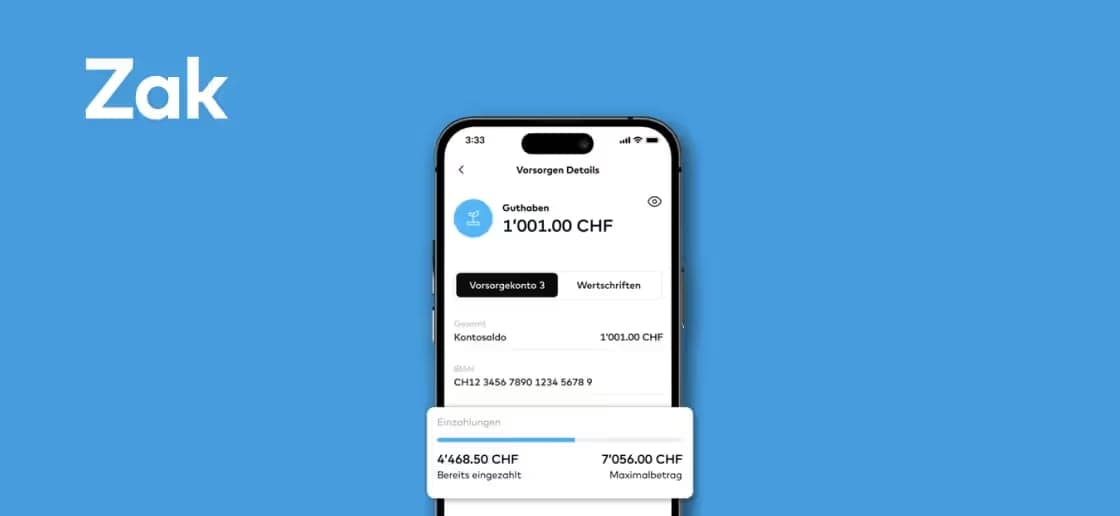
Shared savings pots at the neobank Zak
Zak from Bank Cler doesn’t offer a joint account. The “shared savings pots” let you share a pot within your own account with another person, but the account itself remains an individual account. Bills and eBill can’t be paid directly from a shared pot. Anyone looking for a fully fledged shared account won’t find one at Zak; as a free budgeting aid for couples who want to keep their accounts separate, however, the approach works well.
Welcome offer for opening an account at the neobank Zak
Which joint account suits whom?
Married couples and registered partnerships
Married couples can open a joint account at all Swiss banks. Good to know: even within marriage, the balance in the joint account is attributed to both people vis-à-vis third parties — who it belongs to internally is determined by the matrimonial property regime, not the account contract.
Unmarried couples
The joint account is open to couples; some providers simply require a shared address. For couples who don’t live at the same address, there are also providers that don’t require a shared address (e.g. Yuh and ZKB).
Flatshares
For flatshares of 2 or more people, joint accounts with debit cards are a practical and transparent means of payment. Most digital joint accounts are limited to two people: Yuh&Me and neon duo allow exactly two holders. If you want to run an account with three or four people, you can open a joint account at ZKB or Raiffeisen.
Families
Joint accounts also suit families. For families, a look at the banking packages is worthwhile: cantonal banks and Raiffeisen often combine the joint account with discounted children’s accounts, savings accounts and member benefits.
The best joint account for 3 or more people
If more than two people need a shared account, e.g. in a flatshare, among siblings or in a family with adult children, Evaluno recommends the ZKB joint account.
Recommendation
ZKB partner account
The partner account in the free “ZKB Banking” package can be issued to three or more people while remaining a fully fledged bank account with e-banking, TWINT, eBill and a branch network.
- Advantage: Free account management, even with more than two holders
- Advantage: No shared address required
- Advantage: No individual account required per person
- Advantage: Branches and personal advice
- Disadvantage: 1.25 % exchange rate markup on payments abroad
- Disadvantage: Branches only in the canton of Zurich
What should you know about the ZKB partner account?
Two ZKB Visa Debit cards are included free of charge. From the third ZKB Visa Debit card, each costs CHF 3.30 per month; from the fourth private account, CHF 1 per month.
Requirements for opening a joint account
The requirements for opening a joint account vary by provider. Pay particular attention to the maximum number of holders and whether a shared address is required. The following table shows the key criteria of the three offers Yuh&Me, neon duo and ZKB:
| Provider | Shared address | Own individual account required | Max. number of holders | Digital opening |
|---|---|---|---|---|
| Yuh&Me | not required | yes (both) | 2 | yes |
| neon duo | required | yes (both) | 2 | yes |
| ZKB | not required | no individual accounts required | more than 2 | yes |
Opening a joint account: how it works
- Choose the account model. First decide whether you want a digital account (Yuh&Me, neon duo) or a traditional bank as your provider.
- Check the requirements. Legal age, possibly a shared address, and at Yuh and neon an individual account of your own for each person.
- Complete identification. Digitally via video or online identification, at traditional banks sometimes still in person with ID. Everyone involved must identify themselves.
- Sign the contract. Everyone signs the account contract, digitally in the app or on paper.
- Order cards and set up standing orders. Move rent, internet subscription and recurring bills to the new account; each person sets up their monthly standing order from their personal account.
Tip: keep at least one account of your own alongside it. The joint account is for shared expenses, not meant to be your only account.
Tax, death and deposit insurance
How do I declare a joint account for tax?
If you file separate tax returns (cohabiting couple, flatshare), each person declares their share of the balance and the interest income. For two people that is half each, unless agreed otherwise. Married people declare the account in their joint tax return.
What happens in the event of a separation?
Until the account is closed, both people remain individually authorised to dispose of the joint account. Each person could theoretically empty the account, regardless of who paid in how much. In the event of a separation, you should therefore clarify things and act quickly: stop standing orders, split the balance according to your agreed key and close the account. At most banks, closing the account requires the signature of all holders.
What happens in the event of death?
If an account holder dies, the bank generally informs the heirs and may restrict or block the account until the succession is clarified (even with individual signing authority). How strictly banks handle this can vary.
How high is the deposit insurance?
At banks with a Swiss licence, deposits are protected by esisuisse up to CHF 100'000.
Frequently asked questions
There is none. Joint account is the official banking term for an account with several equal holders; partner account and couple’s account are colloquial names for the same product.
Yuh&Me is completely free: no account fee, no card fee, its own Swiss IBAN, TWINT and eBill included (as of 19 August 2026). ZKB also offers a free partner account. At Bank WIR, the joint account is free with the Top banking package — condition: incoming payments from CHF 1'500/month, pension assets from CHF 20'000, a mortgage from CHF 300'000 or a one-off CHF 200 share certificate. PostFinance also offers the joint account free of charge, with invested assets from CHF 25'000, a mortgage or life insurance.
Yes. Swiss banks and neobanks open joint accounts regardless of marital status. A joint account works for married couples, unmarried couples, siblings or flatmates. Some providers (neon and UBS) require a shared address.
It depends on the provider. neon and UBS require a shared address; others such as Yuh, ZKB and PostFinance don’t.
Not with the digital providers: Yuh&Me and neon duo are limited to two people. ZKB, Raiffeisen and UBS open joint accounts for three or more people as well. For larger flatshares, that is a decisive selection criterion.
Couples and members of a flatshare each declare their share of the balance and interest, normally half per person. Married couples list the account in their joint tax return under assets and interest income.
The bank can restrict or block the account after the death of a holder until the succession is clarified. The joint account should therefore never be the only account, and your emergency fund should stay in your personal account.
At Swiss banks, the esisuisse deposit insurance applies up to CHF 100'000.
In case of doubt, the balance belongs to both people in equal halves, unless agreed otherwise. Each person can have the account blocked. Closing it generally requires both signatures. The simplest way: split the balance amicably, stop standing orders and close the account together.
At many traditional banks, yes: the second person is added as a co-holder after identification. Not at Yuh and neon: there, the joint account is always opened as a new, additional account.
No. Zak offers shared savings pots within an individual account; the account belongs to one person alone, and bills can’t be paid directly from a shared pot. There is no real joint account with two equal holders at Zak.
Not with the digital providers: at both Yuh&Me and neon duo, investing remains reserved for the personal individual account. Anyone who wants a shared custody account needs a traditional bank and a joint account. Since December 2025, Swissquote has offered a joint account where the holders can invest together.
At Yuh&Me, up to four Mastercards (one virtual and one physical per person); at neon duo, two Debit Mastercards (one-off CHF 10 per card). Traditional banks such as ZKB or Migros Bank generally issue one debit card per holder.
Generally not: closing the account requires the signature of all holders. However, each person can usually have the account blocked individually — an important difference in the event of a dispute.
Legal disclaimer
Evaluno does not provide investment, legal or tax advice and is no substitute for personal advice.
Current promo codes
Independence guarantee
Evaluno is committed to neutrality.
- Providers cannot buy a better ranking on Evaluno or influence its assessments.
- Editorial content and comparisons are based exclusively on verifiable facts.
- Partnerships and advertising are always labelled and have no influence on the published results.